The Real Price Is the Filters: Air Purifier TCO, Computed Honestly
Air purifiers are printers: the machine is the teaser, the consumables are the business. Replacement filters run $20-$180 a year depending on brand, which means over a five-year life the filters usually cost more than the purifier — and the brands know you're not doing that math at checkout. We compute a filter-cost-per-year figure for every unit on this site. Here's how to read it, and the traps it catches.
The five-year math, worked
| Setup | Sticker | Filters/year | 5-year total | The lesson |
|---|---|---|---|---|
| Amazon budget unit, pricey filters | $90 | $50 | $340 | The cheap machine is the expensive one |
| Coway AP-1512HH Mighty | $180 | $25 | $305 | Cheap filters beat a cheap sticker |
| Winix 5500-2 | $160 | $40 | $360 | Value king; carbon pellets cost a bit more |
| Premium flagship | $750 | $110 | $1,300 | You pay twice — at checkout and every year after |
| Austin Air HealthMate | $715 | ~$0 (5-yr filter) | $715 + one $360 filter | The huge filter IS the value pitch |
The pattern that emerges from computing this across the whole catalog: filter cost tracks brand pricing power, not filter size. Coway and Winix — companies that compete on value — sell filters near cost. Design-forward and proprietary-tech brands price filters like razor blades, and subscription-first brands (Mila, Molekule) are built on the recurring charge. Meanwhile replacement frequency is a lever brands set as much by revenue as by engineering: 6-month schedules on machines whose filters test fine at 12 months are common. The honest rule from the enthusiast community: replace on performance and smell, not calendar — visible loading, rising auto-mode baseline, or a musty note mean now; an arbitrary date does not. Homes without smokers or wildfire events routinely double the stated filter life with no measurable loss.
The traps: HEPA-type, chipped filters, and subscriptions
'HEPA-type,' 'HEPA-like,' and 'HEPA-style' are unregulated phrases that mean not HEPA — filters that capture in the 85-95% range instead of True HEPA's certified 99.97% at the hardest particle size. They live on budget Amazon listings and in replacement-filter search results, where a $19 'HEPA-type' replacement for your $35 True HEPA filter quietly downgrades the machine you already own. Related scam: third-party replacement filters of wildly variable quality dominate Amazon search for popular models — fine for prefilters, risky for the HEPA stage; the enthusiast consensus is OEM for the HEPA, third-party only from brands independently tested (some are genuinely good and half the price — where that's true for a unit, our listing says so).
Two newer traps deserve names. Chipped filters: a growing list of machines RFID-check their filters and refuse to run — or nag endlessly — with third-party or reset ones; that's a DRM decision, it locks your consumable pricing to one vendor forever, and every unit page here flags it under maintenance. And subscriptions: 'filter membership' pricing that looks painless monthly ($10/mo is $600 over five years) sometimes bundles a warranty extension to make cancellation feel dangerous. None of these are reasons to avoid a genuinely good machine — some chipped-filter units are otherwise excellent — but they belong in the price you compare, which is why our filter-cost-per-year number uses the real-world price of the filters the machine will actually accept.
The pleasant surprises, for balance: washable prefilters are real and standard on good machines — vacuuming the prefilter monthly meaningfully extends HEPA life for free. Austin Air's 5-year filter claim is legitimate (it's five pounds of media in a steel box). Shark's 'NeverChange' 5-year pitch is more marketing-shaped but the underlying oversized-filter logic is sound. And 'washable HEPA' is not real — a HEPA filter that survives washing wasn't HEPA-grade; treat the phrase as a listing red flag.
Carbon: the filter the spec sheet undersells
Particle filters do nothing about gases — cooking odors, VOCs from furniture, smoke smell (as opposed to smoke particles) are all molecular-scale and sail through HEPA media. That's activated carbon's job, and carbon quality is where mid-range and premium machines genuinely differ: the thin dusted-mesh 'odor layer' on budget units saturates in weeks and is mostly theater, while real pelletized carbon by the pound (Winix, Austin Air, IQAir, the premium Coways) adsorbs meaningfully for months. If odors or VOCs are a primary concern — new construction, attached garage, wildfire smell — weight carbon mass heavily and expect its replacement cadence, not the HEPA's, to drive your filter costs; saturated carbon can re-emit what it caught. If your concern is allergies and dust, skip the carbon premium entirely and put the money into CADR.
Units mentioned in this guide
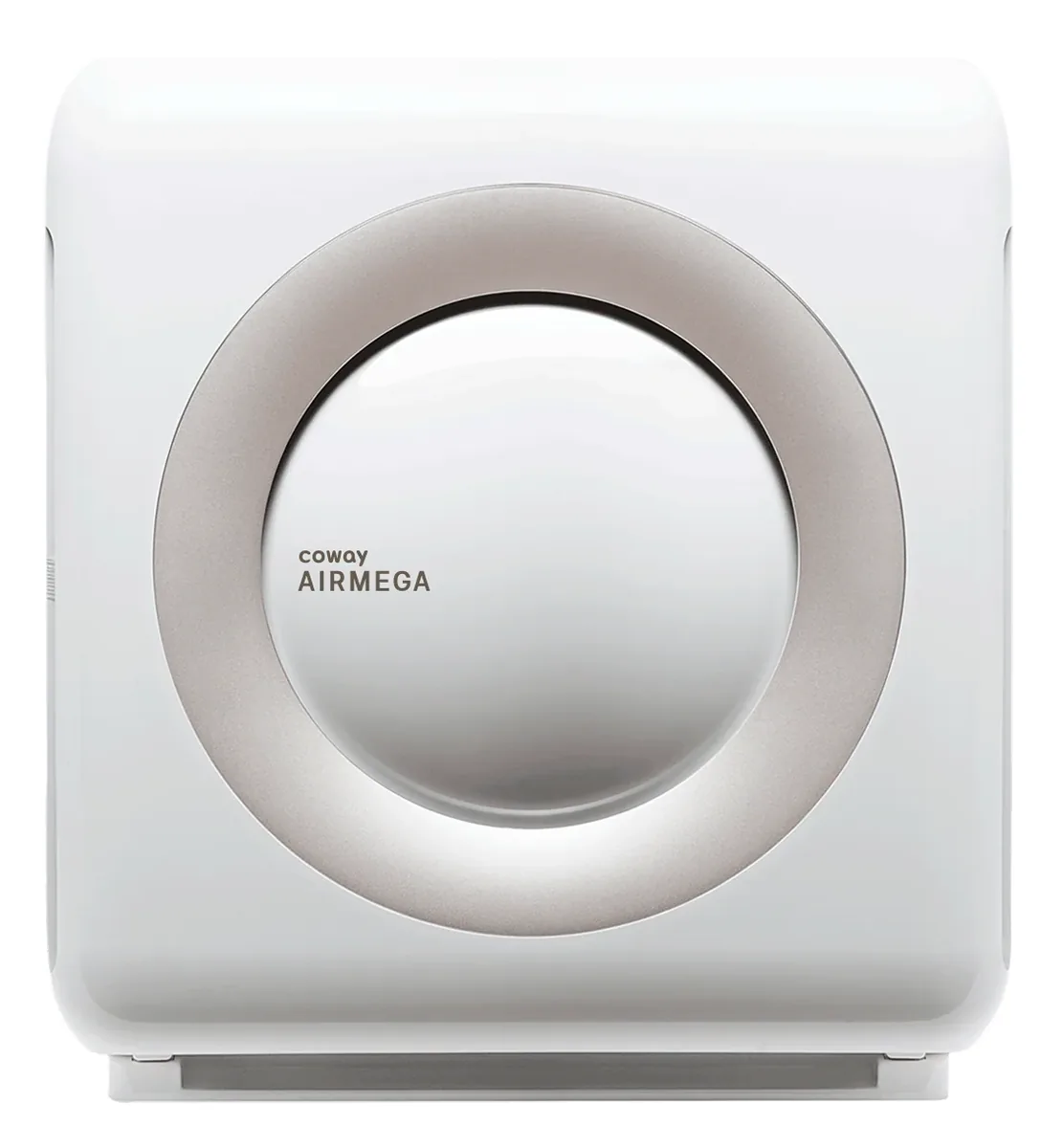
The AP-1512HH is the air purifier the entire industry gets measured against — a Wirecutter top pick for over a decade and still the default air-purifier owner discussions recommendation for a 300-400 sq ft room. The formula hasn't changed: AHAM-verified 233 CFM smoke CADR, a genuinely quiet 24 dB low speed, an eco mode that shuts the fan off when air is clean, and a decade-long track record of motors that simply don't die. HouseFresh's long-term testing repeatedly confirms it outperforms newer, pricier rivals per dollar. The honest caveats: the air quality sensor is dated and slower to react than a Levoit 400S or Winix auto mode, the bright AQ ring needs a manual lamp-off press at night (it doesn't dim automatically on older units), and max speed is audible at 54 dB. The switchable ion feature ('Vital Ion') is best left off. Coway launched a successor, the Airmega Mighty2 (AP-1512N), in March 2026, but the original remains in production and is usually cheaper — buy whichever is on sale. Versus the Winix 5500-2 it trades washable-carbon economy for a longer 3-year warranty and lighter body.
Austin Air
Austin Air HealthMate
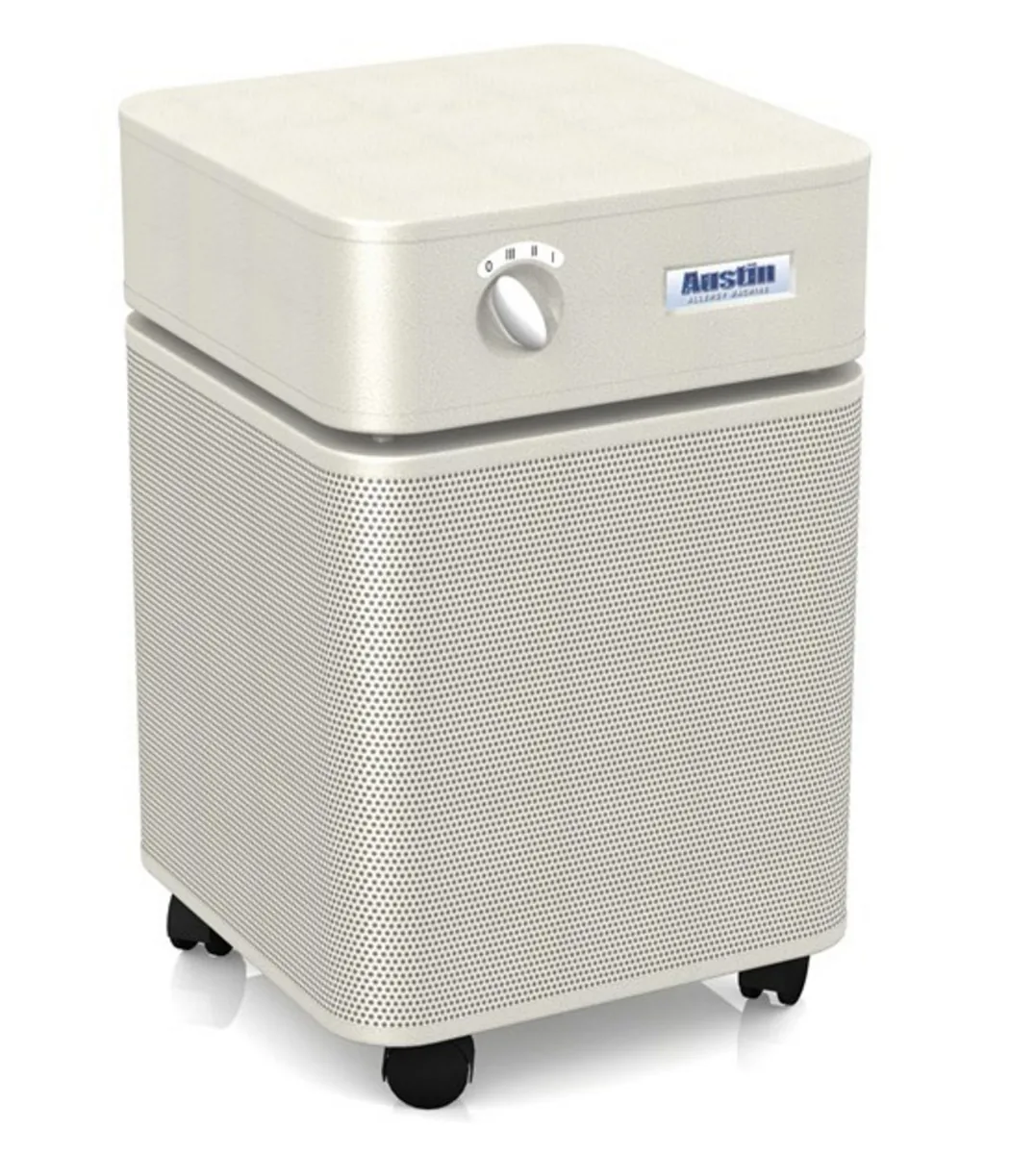
The HealthMate is the steel-box legend: hand-built in Buffalo since the 1980s, used in FEMA and Red Cross deployments after 9/11, and beloved by the chemically sensitive because its filter canister packs roughly 15 pounds of activated carbon and zeolite — more gas-phase media than almost anything else you can plug into a wall outlet. That's the entire pitch, and for VOCs, wildfire smoke odor, and off-gassing it genuinely delivers. For ordinary particles, the math is rough: Austin refuses CADR testing, and HouseFresh measured just 156 CFM of PM1 CADR — it took 52 minutes to clear their test room, performance they compared to a $99 purifier. That makes the 1,500 sq ft claim absurd; realistic coverage at 4.8 ACH is about 240 sq ft. There's no auto mode, no air quality sensor, no timer — three fan speeds on a rotary dial, 47 pounds of powder-coated steel, and a motor that runs loud (42-62 dB measured). The saving grace is ownership cost: one $315 filter every five years is $63/year, cheaper than most $200 purifiers. Buy it for chemical and odor filtration you can't get elsewhere; buy almost anything else for dust and pollen.
Levoit
Levoit Core 300S
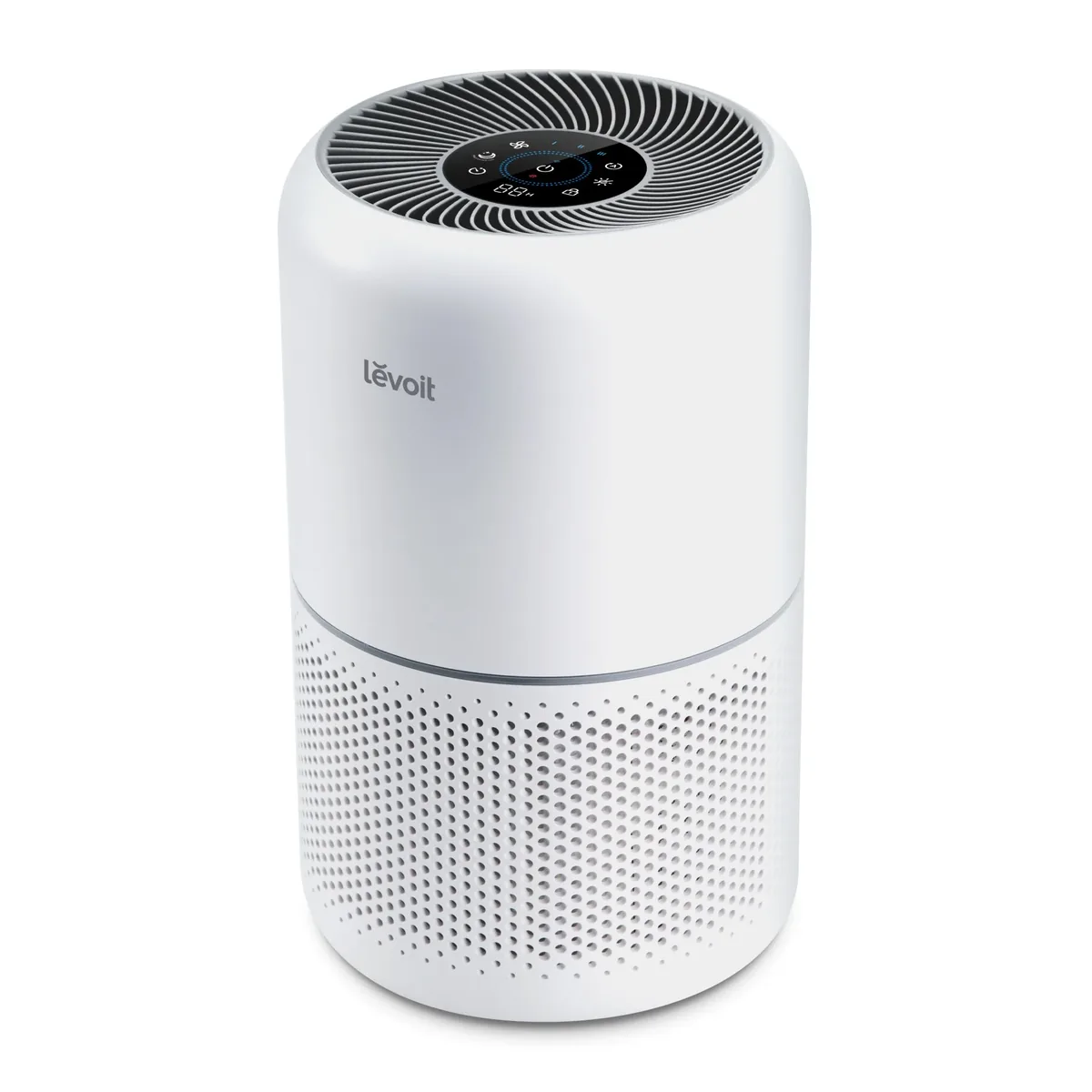
The Core 300S is the smart version of the best-selling air purifier in America, and it earns the throne on value rather than raw power. AHAM-verified 141 CFM smoke CADR from a $110, six-pound cylinder is genuinely good, and HouseFresh's independent testing cleared their test room in 45 minutes — quicker than most rivals at this price. The auto mode is the real upgrade over the base Core 300: the PM2.5 sensor kicks the fan up when you're cooking or the dog shakes off, then drops back to a 22 dB sleep mode you truly cannot hear. The catch is the marketing math — Levoit's '1,095 sq ft' claim is a one-air-change-per-hour fantasy; honest coverage is about 219 sq ft. Air-purifier owner discussions generally recommend it for bedrooms and offices but points buyers to the Vital 100S or Winix 5500-2 for living rooms. Owner gripes are consistent: speed 3 is loud enough (about 50 dB) that most people never use it, the VeSync app nags about filter life on a timer rather than actual usage, and genuine filters at $26-40 mean maintenance can hit half the purchase price annually. Still the default recommendation for a first purifier, and it's earned that.