Austin Air
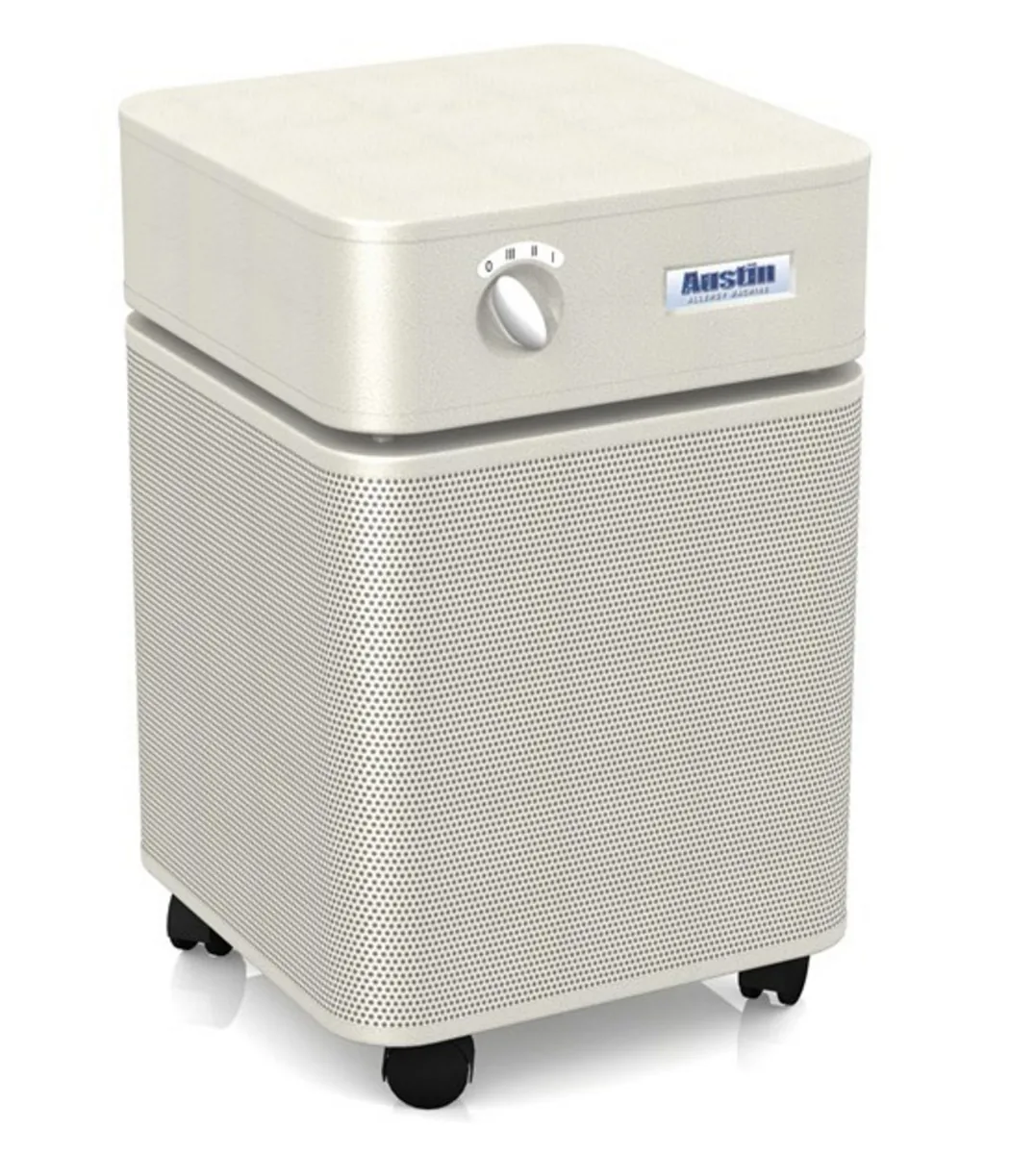
Austin Air HealthMate
The HealthMate is the steel-box legend: hand-built in Buffalo since the 1980s, used in FEMA and Red Cross deployments after 9/11, and beloved by the chemically sensitive because its filter canister packs roughly 15 pounds of activated carbon and zeolite — more gas-phase media than almost anything else you can plug into a wall outlet. That's the entire pitch, and for VOCs, wildfire smoke odor, and off-gassing it genuinely delivers. For ordinary particles, the math is rough: Austin refuses CADR testing, and HouseFresh measured just 156 CFM of PM1 CADR — it took 52 minutes to clear their test room, performance they compared to a $99 purifier. That makes the 1,500 sq ft claim absurd; realistic coverage at 4.8 ACH is about 240 sq ft. There's no auto mode, no air quality sensor, no timer — three fan speeds on a rotary dial, 47 pounds of powder-coated steel, and a motor that runs loud (42-62 dB measured). The saving grace is ownership cost: one $315 filter every five years is $63/year, cheaper than most $200 purifiers. Buy it for chemical and odor filtration you can't get elsewhere; buy almost anything else for dust and pollen.
Specifications
Highlights
Pros
- ✓Unmatched gas-phase filtration — carbon/zeolite bed handles VOCs and odors that particle-only purifiers ignore
- ✓5-year filter life makes long-run cost of ownership lower than most budget purifiers
- ✓Indestructible powder-coated steel housing with wheels — no plastic to yellow or crack
- ✓Zero ozone, no ionizer, no electronics to fail
- ✓Made in Buffalo, NY with a 5-year warranty and decades of clinical-use history
- ✓Used in hospital and university studies (Cincinnati Children's, Johns Hopkins)
Cons
- ✗Particle performance is $99-purifier grade: HouseFresh measured only 156 CFM PM1 CADR from a $845 machine
- ✗1,500 sq ft claim is wildly optimistic — about 240 sq ft at a real 4.8 ACH
- ✗Loud: 42 dB minimum means even its low speed is audible in a bedroom
- ✗No auto mode, sensor, timer, or remote — 1980s feature set at a 2026 price
- ✗47 lbs and drum-sized; dominates a corner of the room
- ✗Owner ratings lag the category, mostly over shipping damage and noise
Common Questions
Why would anyone pay $845 for this when cheaper purifiers clear particles faster?
Does the filter really last 5 years?
How much space does it cover, honestly?
Can I sleep in the same room as it?
What features does it have?
Compare the Austin Air HealthMate
Related air purifiers
Coway
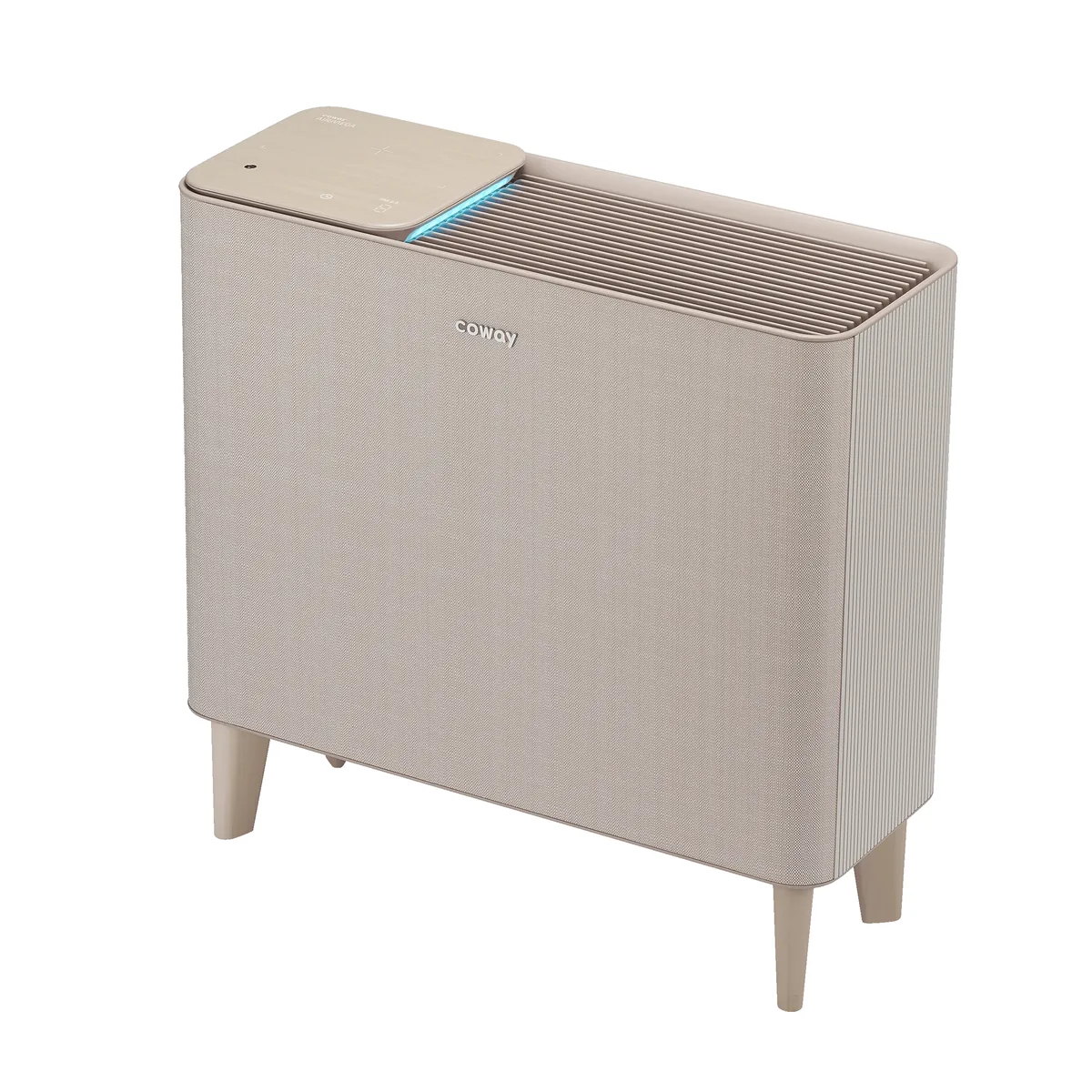
Coway Airmega IconS
The IconS answers a question mostly asked in design magazines: what if an air purifier looked like a mid-century console table and charged your phone? It's Coway's design-line flagship — a slanted-leg cabinet with a Qi wireless charging pad on top and the WiFi/app/voice features the plain Icon lacks. The catch is that you know exactly what Coway airflow costs, because Coway sells it to you cheaper elsewhere: this is 173 CFM of smoke CADR for $749, while the company's own dowdier Airmega 300S delivers roughly double the airflow for hundreds less, and the legendary Mighty (AP-1512HH) gets within shouting distance for a fifth of the price. Reviewers at TechHive and Reviewed liked the thing itself — build quality is real, the particle sensor is responsive, Eco mode shuts the fan off when air stays clean, and 21 dB on low is bedroom-grade silent. But the 649 sq ft claim leans on a 2 ACH assumption; honest 4.8 ACH coverage is about 268 sq ft, medium-room duty. Air-purifier owner discussions' shorthand for this machine is 'the Coway you buy with your eyes.' If the IconS's furniture act is what gets a purifier allowed into your living room, it's a competent, well-supported machine. If not, Coway's own catalog is the strongest argument against it.
Samsung
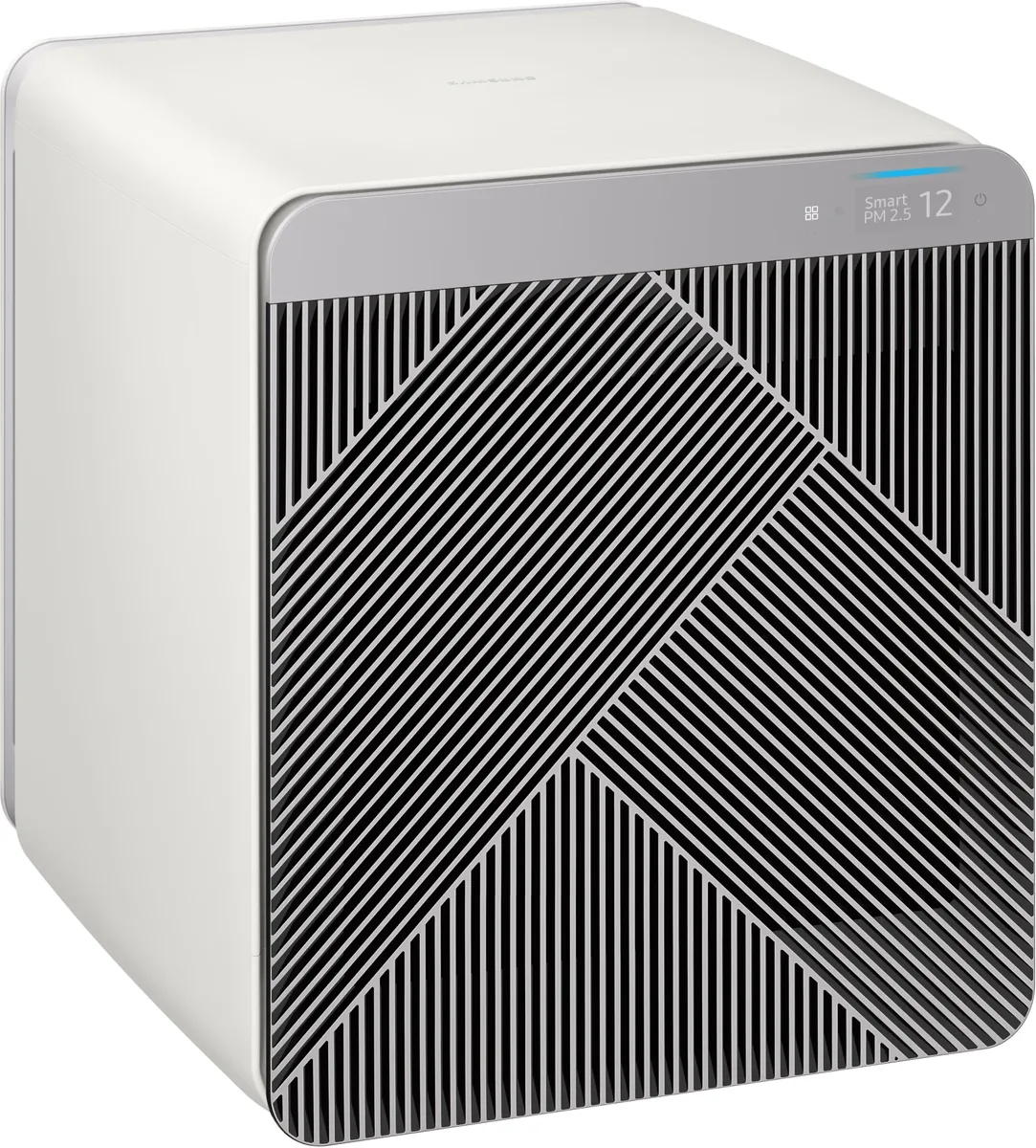
Samsung Bespoke Cube
The Bespoke Cube is Samsung's furniture-first purifier: a fabric-wrapped 17-inch cube designed to pass as a side table, with a 'Wind-Free' mode that exhales air through thousands of micro-perforations so nothing blows on you while it cleans. Credit where it's genuinely due: the 350 sq ft rating is AHAM Verifide and Energy Star certified — Samsung claims exactly what the machine does (~226 CFM implied smoke CADR), which makes it nearly the only marketing-honest coverage number in this entire specialty batch. It's also spectacularly quiet at the bottom end: 18 dBA in sleep mode and 24 dBA in Wind-Free, inaudible in a way even the quiet Scandinavian brands can't match. The problems are price and commitment. $600 buys medium-room airflow that a $230 mainstream machine matches, SmartThings integration is lovely only if you live in Samsung's ecosystem, and the warranty is a thin 1 year. Most concerning, owners already report replacement-filter availability flickering at Samsung's parts channels — the classic appliance-giant pattern where a low-volume side product quietly loses consumables support. As a nightstand-adjacent bedroom machine for a Samsung household, it's genuinely pleasant. As clean-air value, an AirFanta 3Pro delivers 50% more measured CADR for a quarter of the price.
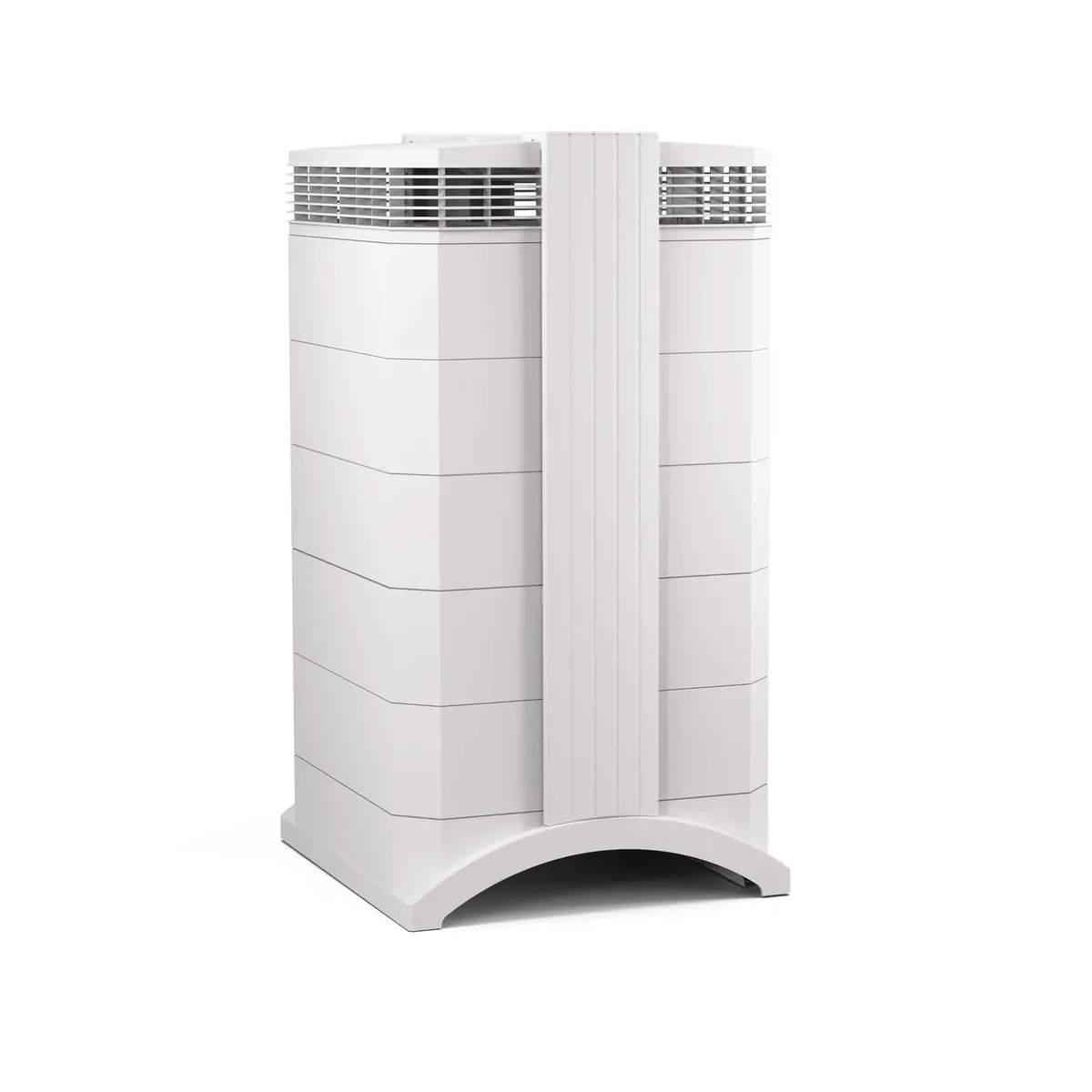
The HealthPro Plus is the machine allergists have name-dropped for two decades, now sold as the WiFi-equipped XE version at $1,199. The Swiss-designed, German-built tower is genuinely excellent at what it claims: a fully sealed system with HyperHEPA filtration independently tested down to 0.003 microns, plus five pounds of gas-phase media in the V5-Cell. HouseFresh, no fan of overpriced purifiers, still calls it the best pure HEPA-plus-carbon machine on the market. But the value math is brutal. IQAir refuses to publish AHAM CADR — HouseFresh measured 213 CFM of PM1 CADR at top speed, which works out to roughly 330 sq ft at a real 4.8 ACH, not the 1,125 sq ft on the box. Worse, its sub-45 dBA CADR is just 86 CFM: run it at livable volume and you forfeit about 70% of its capacity. An AirFanta 3Pro delivers more measured clean air for about a fifth of the price, and running costs here exceed $400 a year. You are paying for build quality, gas filtration depth, a 10-year warranty, and the medical pedigree — not for CADR-per-dollar.
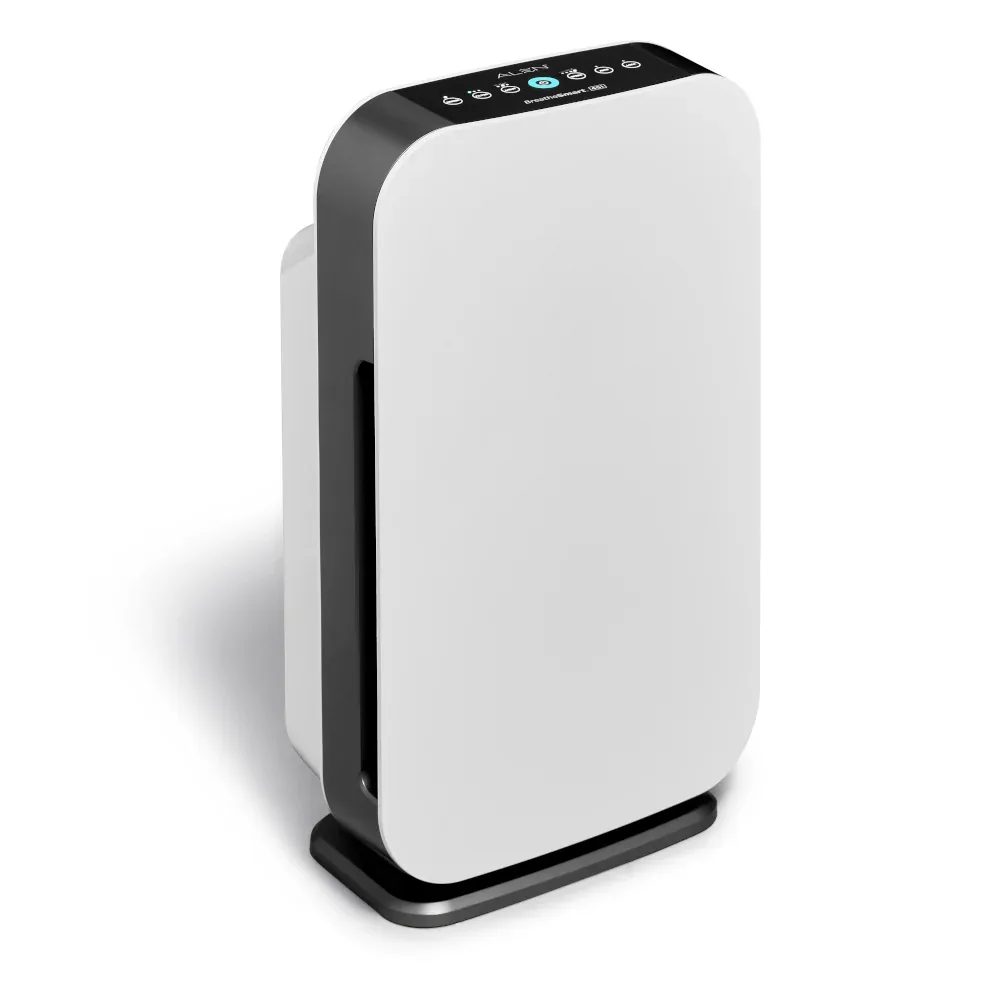
The 45i is a beautifully built, whisper-tuned purifier wrapped in the most inflated coverage claim in the mainstream market. Alen advertises 800 sq ft, but that's at a leisurely 2 air changes per hour; the AHAM smoke CADR is just 194 CFM, which works out to about 300 sq ft at the real 4.8 ACH standard - we classify it as a medium-room unit accordingly, and HouseFresh independently pegs it at 297 sq ft at 5 ACH. Their testing needed 30 minutes to clear the smoke test room, slower than a $150 Winix 5500-2 or Levoit Vital 200S. So why does it hold a 4.8-star average at Best Buy? Because what Alen actually sells is refinement: a 23 dB floor with pink-noise-tuned fan acoustics many owners run in bedrooms, a responsive laser sensor with app control, designer front panels, a switchable low-ozone ionizer, and a genuine lifetime warranty. That warranty has strings - it's void unless you maintain a filter subscription or use only Alen filters, which locks you into $70-120/yr B4 cartridges depending on variant. owner regulars respect the build but consistently note you're paying $430 for ~$180 of airflow. Buy it for the quiet, the looks, and the warranty relationship - not the square footage on the box.
Windmill
Windmill Air Purifier
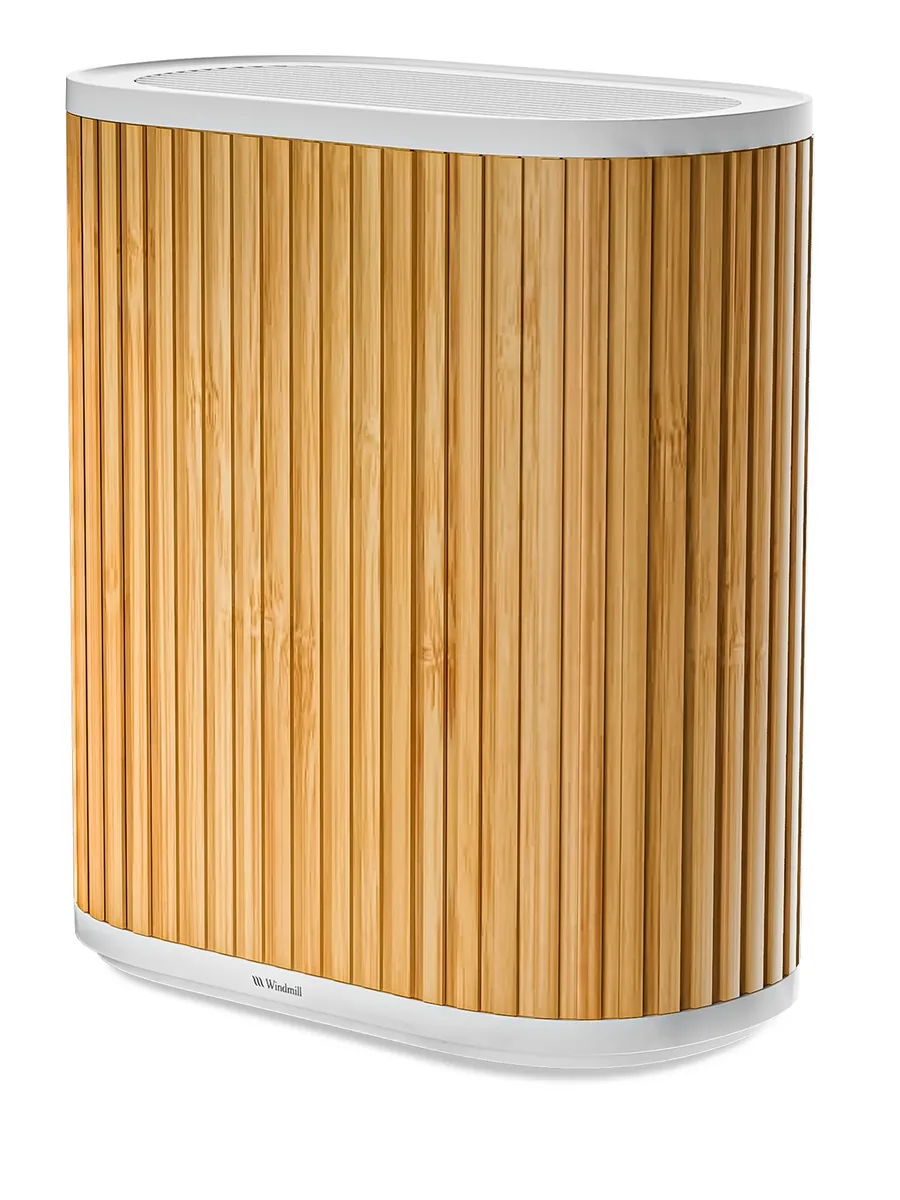
Windmill is the Brooklyn design brand that made window air conditioners Instagram-worthy, and this purifier applies the same playbook: soft grille, muted colors, wood-look top, and a UI your grandmother could operate. To their genuine credit, the spec sheet is AHAM Verifide and refreshingly honest — Windmill itself publishes 202 sq ft at a real 4.8 ACH, even while the marketing tops out at a '975 sq ft' whole-room number. The measured reality is modest: 130 CFM smoke CADR is Levoit-Core-300-class airflow at roughly double the price, so you are unambiguously paying a design premium per unit of clean air. Where it earns some of that back is livability: reviewers at Tom's Guide and CNN Underscored consistently praise the near-silent low end (Windmill claims 16 dB Whisper mode; independent reviewers measure roughly 23 dB), the polished app with Eco auto mode, and a form factor that doesn't look like lab equipment. The catch worth naming: the 'lifetime warranty' is contingent on an active $49-every-6-months filter subscription — warranty-as-retention-tool, the same trick Mila plays with softer branding. As a bedroom or office machine for design-driven buyers it's likable; value nerds should note an AirFanta 3Pro moves 2.7x the air for less money.
Blueair
Blueair Blue Pure 411i Max
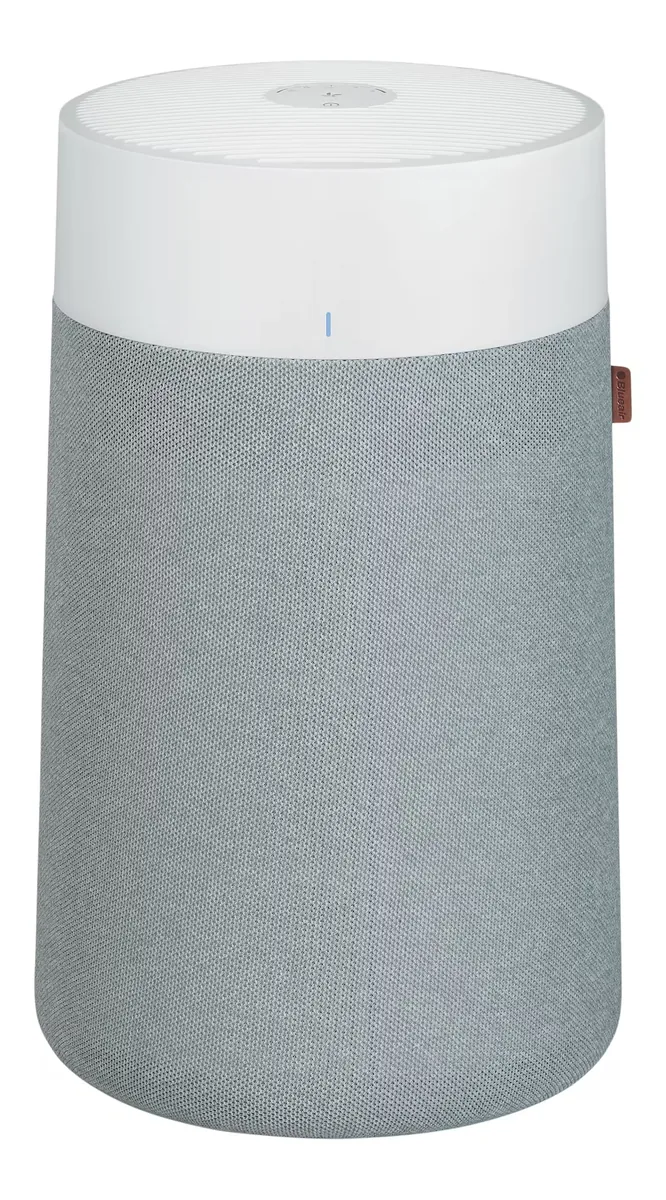
The 411i Max replaced Blueair's discontinued Blue Pure 411/411+ as the entry point to the brand's HEPASilent system, which pre-charges particles electrostatically so a looser, quieter filter can catch them. The payoff is a spec sheet nothing else in this class touches: 141 CFM AHAM-verified CADR - matching a Levoit Core 300S - at a claimed 18 dB minimum and single-digit wattage on low, quiet and efficient enough to run around the clock for pennies. Blueair's honest AHAM figure is 219 sq ft at 4.8 air changes; the '1,052 sq ft' retail headline is the usual one-hour math. You get an app, auto mode with a particle sensor, and a washable fabric pre-filter sleeve. Caveats: Live Science measured real-world noise closer to 23-53 dB than the spec, list price is $170 (it routinely discounts toward $120 - wait for that), and the electrostatic charging stage is technically mild ionization, though Blueair's ozone output tests below detection limits and CARB certifies it. The base 1-year warranty trails Levoit and Winix unless you register for the extension. Air-purifier owner discussions treat Blue Pure models as the default 'quiet bedroom' pick, and independent testing has consistently backed that reputation.