Air Purifier Sizing: ACH Math Instead of Marketing Math
Air conditioner buyers oversize; air purifier buyers undersize — not through any fault of their own, but because the box told them a 141-CADR machine covers a thousand square feet. The result is the most common complaint in every purifier review section: 'ran it for a week, can't tell any difference.' The machine is fine. The math was fiction. Here's the real version, which is short.
The target: 4-5 air changes per hour
Air purification is a rate war: your purifier removes particles while infiltration, cooking, pets, and you yourself add them back. The steady-state particle level in the room settles wherever those rates balance, which is why runtime matters more than any burst of cleaning and why the air-changes-per-hour target exists. The clean-air community consensus — driven by COVID-era ventilation research and wildfire practice — is 4-5 ACH for meaningful protection: allergy and asthma relief, wildfire smoke defense, and the levels at which indoor PM2.5 measurably tracks toward outdoor-clean-day numbers. At 1 ACH (the marketing standard) a serious particle source simply outruns the machine.
The math is one line: required CADR ≈ room sq ft × ceiling height × ACH ÷ 60. A 300 sq ft living room with 8-foot ceilings at 5 ACH wants (300 × 8 × 5) ÷ 60 = 200 CFM of smoke CADR. Or skip the arithmetic and use the AHAM shortcut — honest coverage ≈ smoke CADR × 1.55 — which bakes in the same assumptions. Vaulted ceilings scale it directly: a 10-foot ceiling means 25% more volume, so treat a 300 sq ft room as 375.
The chart, honestly
| Room | Typical size | Smoke CADR to buy | The class this puts you in |
|---|---|---|---|
| Kid's room / office | 100-150 sq ft | 80-120 CFM | Budget compacts — the $60-100 tier genuinely suffices |
| Standard bedroom | 150-250 sq ft | 130-180 CFM | Core 300S / Blue Pure 411 class |
| Primary bedroom | 250-350 sq ft | 180-250 CFM | Coway Mighty / Winix 5500-2 class — the value sweet spot |
| Living room | 350-500 sq ft | 250-350 CFM | Core 600S / Airmega 400 class |
| Open plan / great room | 500-800 sq ft | 350-550 CFM | EverestAir / XL class — or two mid-size units |
| Whole floor | 800+ sq ft | 550+ CFM or multiple units | One unit can't fight closed doors — see below |
Two class-jumping notes. Buying one size up from your room is the single best noise upgrade in the category: a 250-CADR machine loafing at 40% speed in a bedroom is near-silent while still delivering more clean air than a 150-CADR machine at full 52 dB shriek — 'bigger, run slower' is the veteran move all over air-purifier owner discussions. And portables-vs-rooms logic doesn't transfer from HVAC: purifiers only clean the room they can see. Air exchange through a doorway is poor and through a closed door is nil, so a hallway flagship does not clean three bedrooms. For bedrooms-plus-living-room coverage, the winning pattern is one right-sized unit per room that matters — which, given how good $90 machines have gotten, usually costs less than the one oversized flagship anyway.
Placement and runtime: the free 30%
Two habits cost nothing and swing results more than a size class. Placement: a purifier jammed against a wall or in a corner recirculates its own output; give it 12-18 inches of clearance and a spot near (not inside) the particle path — near the bedroom door if hallway air leaks in, between the kitchen and the sofa for cooking smoke. Elevating small units off the floor a foot or two helps them see the room. Runtime: purifiers are steady-state machines, so run them 24/7 on auto — the 'run it an hour before bed' pattern fights a losing rate battle from scratch every evening. The electricity fear is obsolete: an Energy Star mid-size unit on low-to-auto draws 5-30W, call it $1-4 a month. Filters, not watts, are the real operating cost, and that gets its own guide.
Units mentioned in this guide
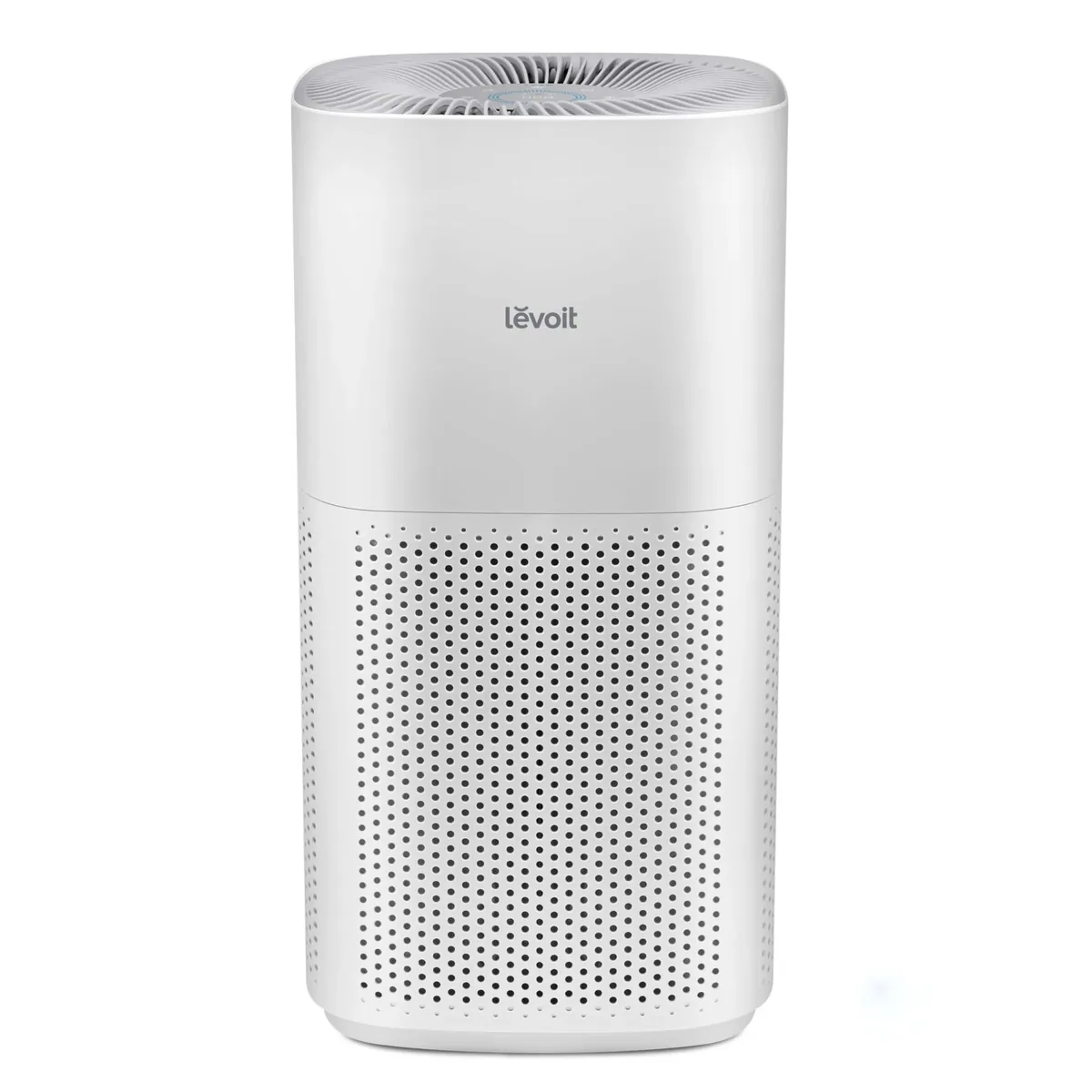
Levoit
Levoit Core 600S
The Core 600S is the value benchmark in large-room purification, and it's the unit air-purifier owner discussions most often recommends when someone asks how to clean serious square footage without spending $500. The AHAM-verified numbers are real: 410 CFM smoke CADR - more than the EverestAir that costs twice as much - which honestly covers 635 sq ft at 4.8 air changes per hour. HouseFresh called it the best cheap option for large rooms, measuring 24 dB on sleep mode and about 48-49 W at full tilt, and Levoit's claimed figures held up under their testing, which is not something every brand in this class can say (see AirDoctor and Medify). The 3,175 sq ft marketing claim is the usual 1-ACH nonsense - divide by five. Compromises are cosmetic rather than functional: it's a plain white drum that looks like a shop vac next to a Rabbit Air A3, the display shows only a single PM2.5 number from a decent laser sensor, and max speed is a whooshy 55 dB. Filters are cheap ($60/yr), the VeSync app works well, and there's no subscription or DRM anywhere. If you don't care about looks, this is the large-room purifier to beat under $300.
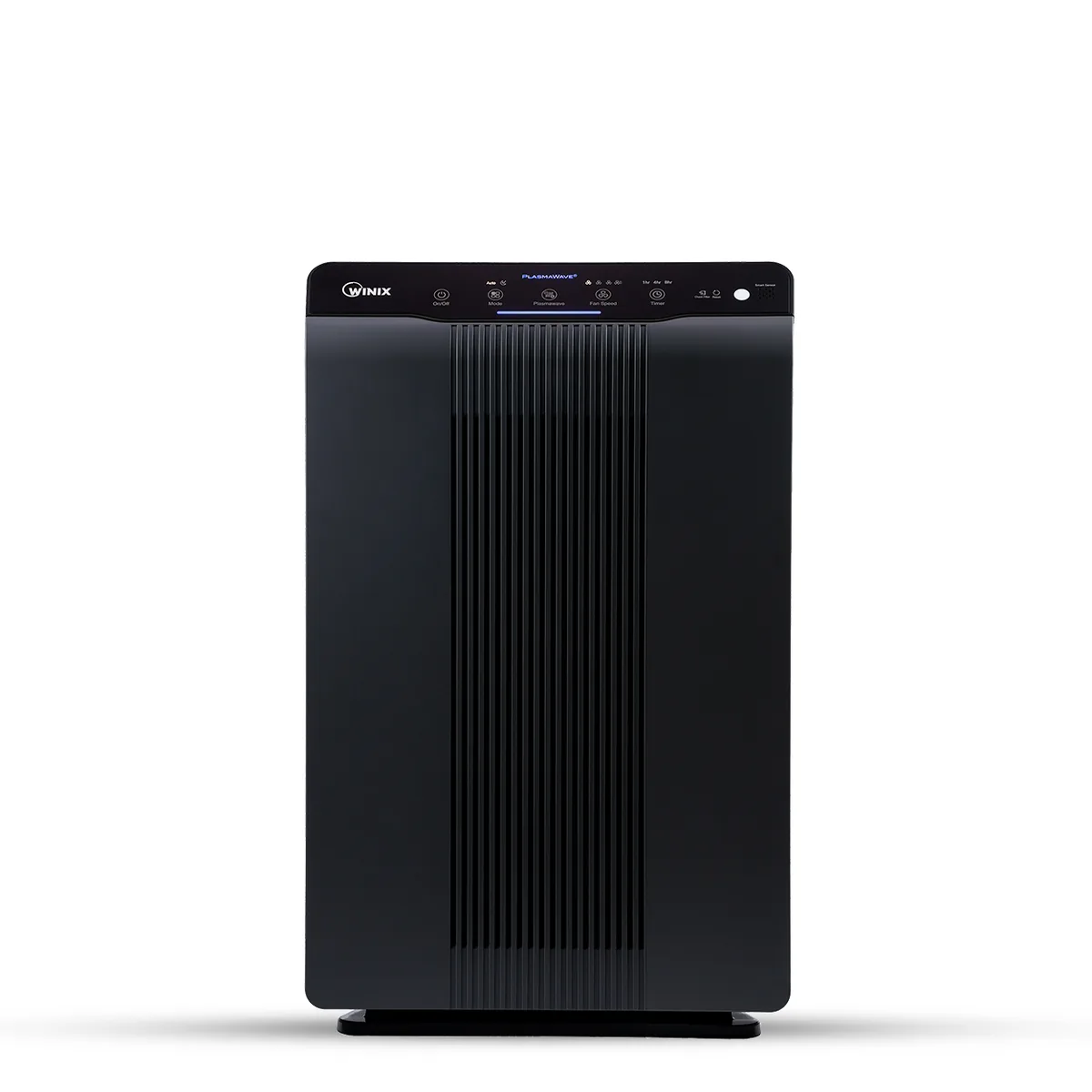
Winix
Winix 5500-2
The 5500-2 is air-purifier owner discussions' undisputed value king — the answer to roughly every third 'what should I buy' thread for years. Its AHAM-verified 232 CFM smoke CADR matches the Coway Mighty, but it adds a genuinely useful washable AOC carbon filter (real pelletized-carbon odor removal, not a dusted sheet) and one of the best auto modes at any price, backed by HouseFresh testing that clocked it clearing their test chamber faster than machines costing $100 more. Now the asterisk: Winix confirmed in 2025 that the 5500-2 and 5300-2 are discontinued in North America once inventory sells through, replaced by the Winix 5510. Filters will keep shipping until 2032, so buying one today is still safe, and street prices around $160 (often $130 on sale) remain the class's best CADR-per-dollar. Compared with the Coway you give up a year of warranty and a few dB at the top end (65 dB turbo is loud), and gain better odor handling and the superior sensor. PlasmaWave is Winix's plasma ionizer — it's switchable, and most owners run with it off. If you see it on clearance, this is still the smart-money buy of the entire mid-size class.
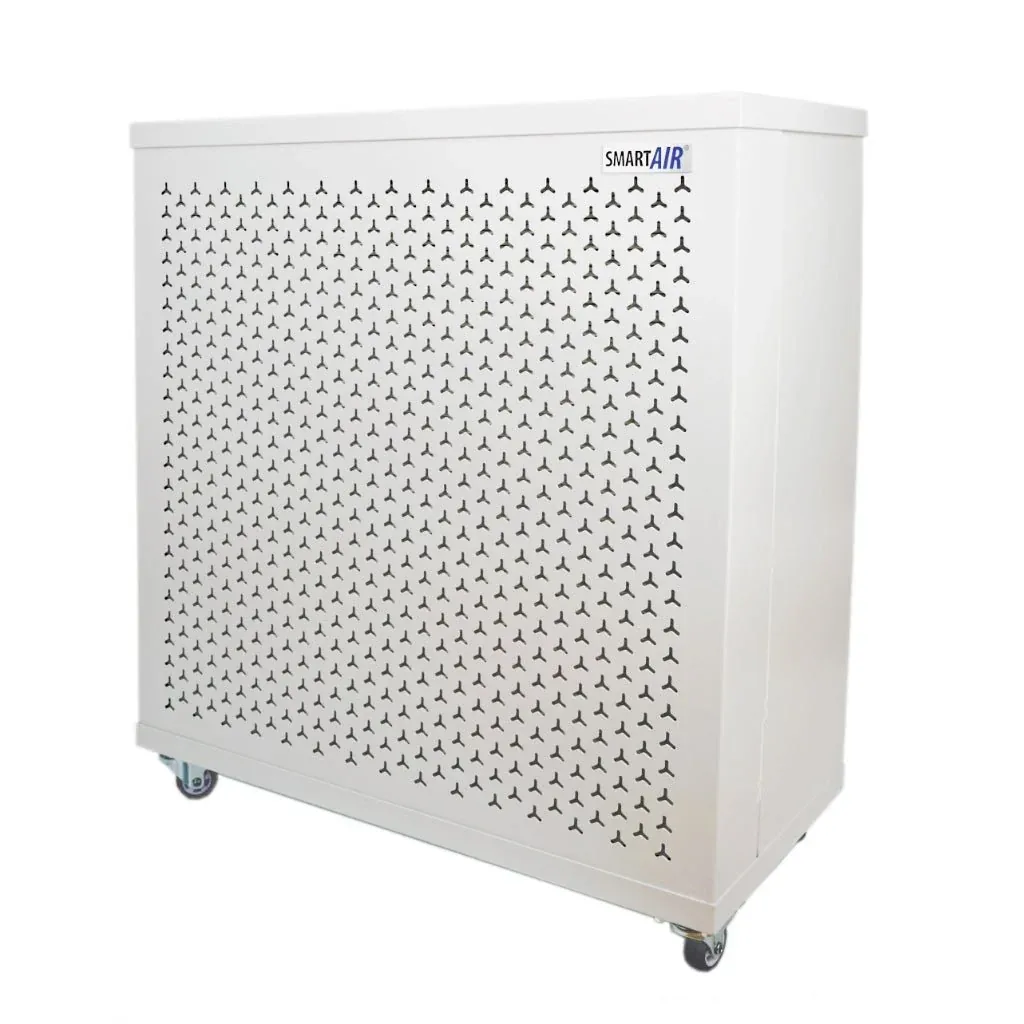
Smart Air
Smart Air Blast Mini Mk II
The Blast Mini is what happens when an engineering-first company decides the answer to big spaces is simply a bigger filter: a 59-pound powder-coated steel cabinet on lockable wheels pushing air through a single HEPA panel the size of a bar stool. It is the most powerful purifier HouseFresh has ever tested — 400 CFM of measured PM1 CADR, clearing their 728 cu ft test room in 15 minutes, faster than the Levoit EverestAir, AirDoctor 3000, and the $1,200 IQAir HealthPro Plus. The party trick is quiet bulk cleaning: 272 CFM of PM1 CADR while staying under 45 dB, more sub-45 dB clean air than any other unit HouseFresh measured here and triple what the IQAir manages at the same loudness. That's the fan-filter physics of a huge, low-restriction filter doing its thing. The trade-offs are physical and philosophical: it's furniture-sized, 45 dB is its floor (no whisper mode), there are zero smart features, and 123W at full tilt shows up on your power bill. Schools and clinics in the UK's Safe Air Schools program spec this machine for classrooms, which is exactly its natural habitat — open-plan offices, studios, great rooms, basements. For a normal bedroom it's absurd. For 600+ honest square feet, almost nothing touches it per dollar.