Is It Actually Working? Monitors, Auto Mode, and Honest Expectations
An air purifier does its work invisibly, on particles you can't see, against a baseline you never measured. This breeds the category's twin failure modes: people running placebo machines happily for years, and people returning perfectly working units after a weekend because the dresser still gathered dust. Both have the same cure — actually measuring — and it costs thirty dollars. Here's how to verify, what to expect on what schedule, and the short list of reasons a working machine isn't working.
The thirty-dollar truth serum
A standalone PM2.5 monitor — the cheap laser-scatter units are accurate enough for this job — turns faith into data in one evening. The experiment every convert runs: note the baseline, sear something on the stove and watch the number spike into the hundreds, then watch the purifier drag it back down over twenty to forty minutes. That decay curve is the machine working, visibly, and it also calibrates your expectations: you'll see how fast your unit clears a real event at each fan speed, which is worth more than any spec sheet. Owners who do this stop asking whether the machine works and start noticing when it isn't — a slow decay curve is how you catch a loaded filter or a blocked intake months before you'd otherwise notice.
The same monitor settles placement arguments (run the test with the unit in the corner, then with clearance — the difference shows up in minutes) and sizing doubts (if a cooking spike takes two hours to clear, the room has outgrown the machine). If thirty dollars is thirty dollars, the sunbeam test is the free approximation: fine airborne dust is visible in low-angle direct sunlight, and the before/after difference with a purifier running is obvious. Less precise, same conclusion.
Auto mode: trust, but verify once
Auto mode's promise — the machine senses pollution and responds — is real on machines with decent sensors and oversold on machines without them. The built-in particle sensors on budget units are small, drift with dust accumulation, and sit inches from the purifier's own clean-air output, which means they can read 'clean' while the far side of the room isn't. The one-evening verification: put your standalone monitor across the room, trigger a spike, and watch whether auto mode actually ramps. Good sensors (the mid-tier and up from the major brands) pass visibly; passers can be trusted for daily duty, which is genuinely the best way to run a purifier — it handles cooking and pollen events you'd never catch manually, at lower average noise than any fixed speed.
Machines that fail the test aren't garbage — they're manual machines with a decorative button. Run them at the highest speed the room tolerates and clean the sensor port (a quick vacuum per the manual) before writing off auto entirely; sensor drift from dust is the most fixable cause. And regardless of sensor quality, sleep hours are the exception to auto-trust: most auto modes ramp loudly at 3 a.m. over a dust event nobody's awake to inhale, which is why sleep mode — locked low speed, display off — exists and is the correct overnight setting in a bedroom.
Timelines: what changes when
Same-day: visible smoke and cooking events clear in under an hour in a right-sized room, and the sunbeam haze thins. Days: cooking and pet smells fade faster than they used to (with real carbon aboard), and the monitor's overnight baseline drops into single digits. Weeks: this is where allergy relief lives — less morning congestion, fewer symptom days — and where dust accumulation visibly slows, though never stops (the physics is in our allergies-and-dust guide). What never happens on any timeline: dust-free furniture, a smell-proof litter box, or relief from anything that isn't airborne. If you know which shelf each expectation sits on, the machine gets judged fairly — most 'it does nothing' returns are day-two verdicts on week-three benefits.
The troubleshooting list, in order of likelihood
First, and not a joke: check that the filter is out of its plastic bag. Filters ship wrapped, the wrap is invisible once the cover's on, and 'remove filter, unwrap, reinstall' is the single most common resolution in every brand's support threads and half the one-star 'doesn't work' reviews. Second: the new-filter smell — a plasticky or faintly sour note for the first days — is normal off-gassing from fresh media and glue, harmless, and gone within a week of continuous running; run it on high with a window cracked if it bothers you. (A musty or burnt smell months in is different: musty means a damp or exhausted filter, burnt means stop using it.)
Then, in order: an undersized machine for the room (re-run the sizing math against honest coverage, not the box claim); placement in a corner or against furniture recirculating its own output (give it 12-18 inches); a loaded prefilter strangling airflow (vacuum it — takes two minutes and restores a startling amount of performance); a genuinely exhausted HEPA filter well past its life in a smoky or pet-heavy home; and last, an actual defect, which is rarer than everything above combined. Run the monitor test after each fix and the culprit identifies itself — the decay curve doesn't lie.
Units mentioned in this guide
Levoit
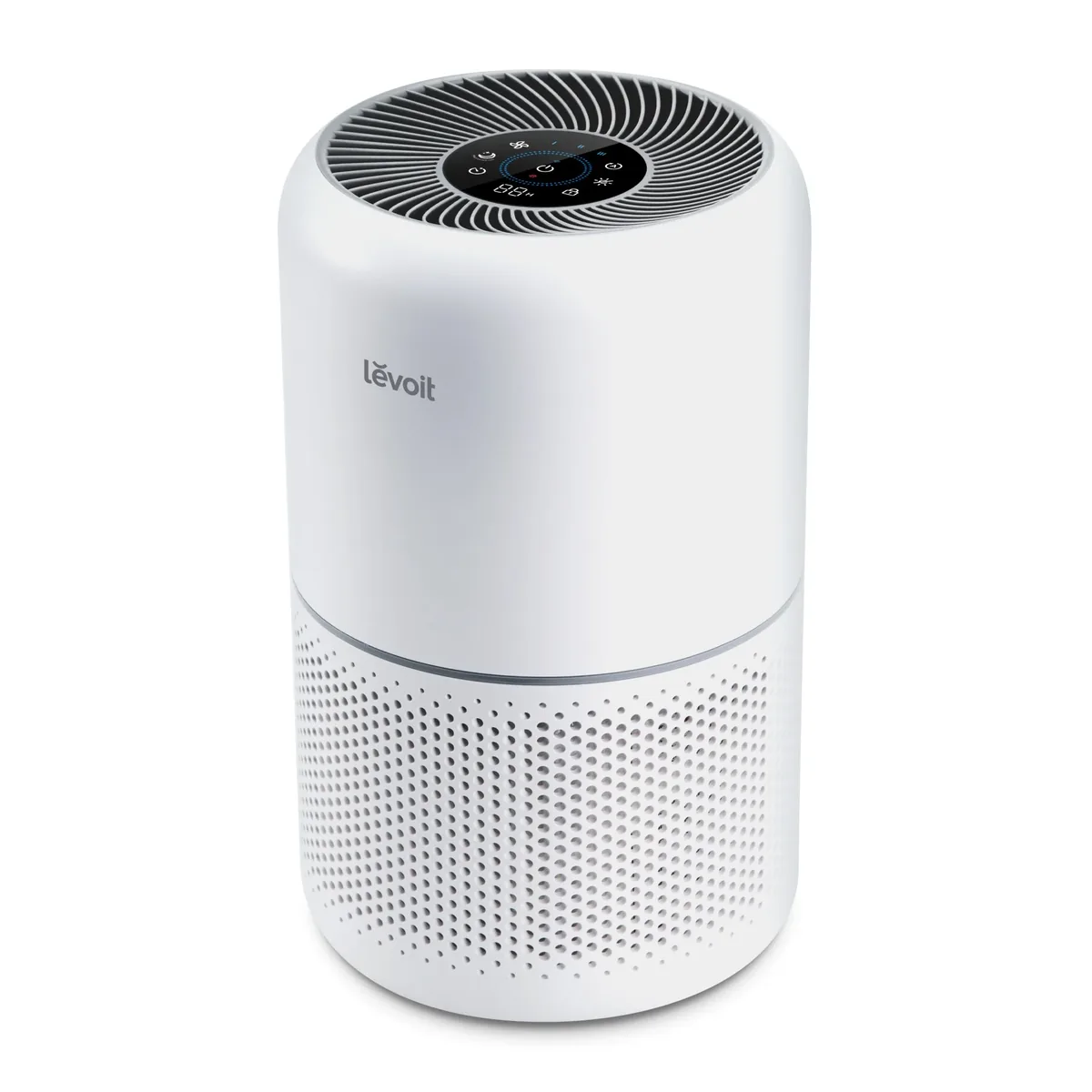
Levoit Core 300S
The Core 300S is the smart version of the best-selling air purifier in America, and it earns the throne on value rather than raw power. AHAM-verified 141 CFM smoke CADR from a $110, six-pound cylinder is genuinely good, and HouseFresh's independent testing cleared their test room in 45 minutes — quicker than most rivals at this price. The auto mode is the real upgrade over the base Core 300: the PM2.5 sensor kicks the fan up when you're cooking or the dog shakes off, then drops back to a 22 dB sleep mode you truly cannot hear. The catch is the marketing math — Levoit's '1,095 sq ft' claim is a one-air-change-per-hour fantasy; honest coverage is about 219 sq ft. Air-purifier owner discussions generally recommend it for bedrooms and offices but points buyers to the Vital 100S or Winix 5500-2 for living rooms. Owner gripes are consistent: speed 3 is loud enough (about 50 dB) that most people never use it, the VeSync app nags about filter life on a timer rather than actual usage, and genuine filters at $26-40 mean maintenance can hit half the purchase price annually. Still the default recommendation for a first purifier, and it's earned that.
AirFanta
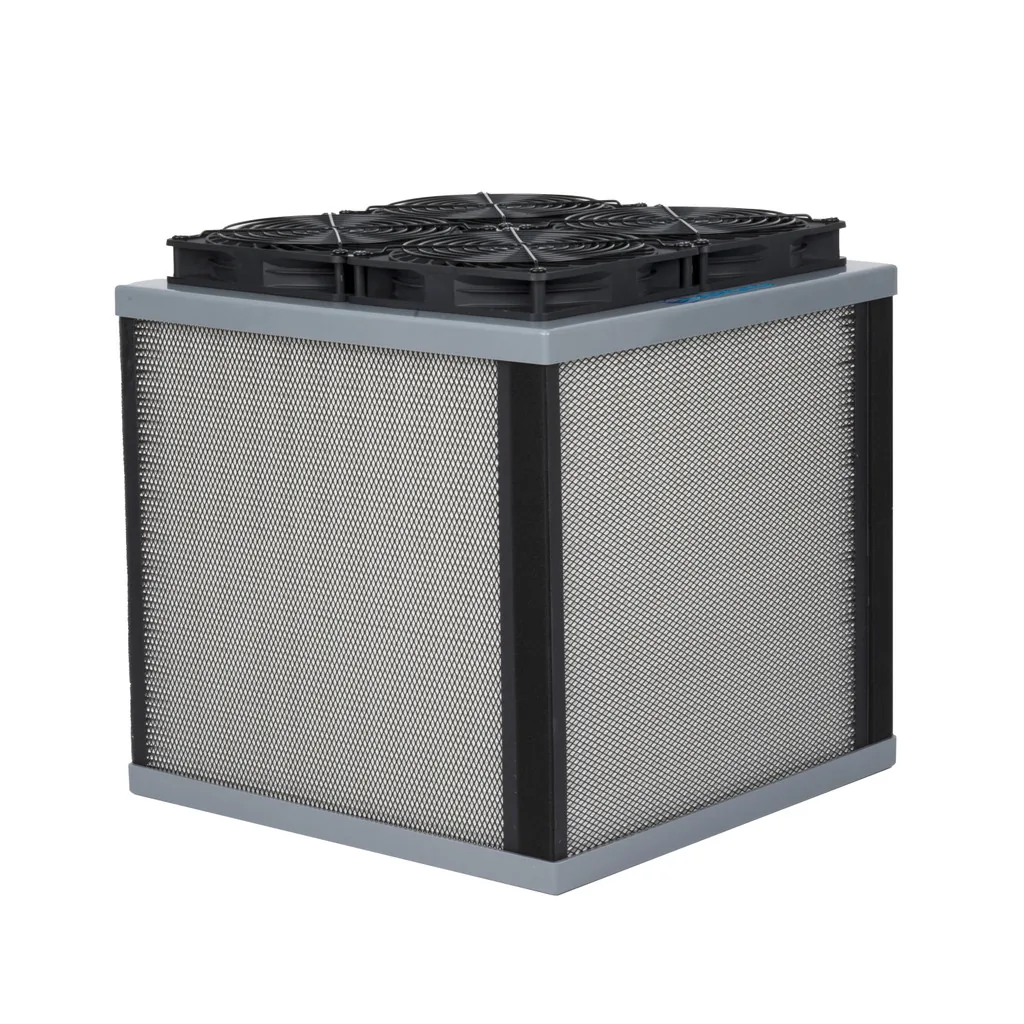
AirFanta 3Pro
The 3Pro is the Corsi-Rosenthal box graduated from duct-tape science project to actual product: four HEPA panels clipped into a cube with four PC fans on top, disassembling flat enough to fit in a carry-on. The numbers are silly for the price. HouseFresh measured 353 CFM of PM1 CADR — more measured clean air than the $1,200 IQAir HealthPro Plus, the $1,015 Molekule Air Pro, and the $550 Dyson TP07 combined margin of error — and their test room cleared in 17 minutes, quicker than machines costing $450+. Even throttled below 45 dB it still delivers 213 CFM, and max power draw is a modest 43W. This is the machine air-purifier owner discussions mean by 'CADR per dollar,' and it's become the default rebuttal to every premium purifier thread. Now the honesty: the 3,100 sq ft claim assumes a uselessly lenient 1 ACH (real 4.8 ACH coverage is ~530 sq ft), it's louder at full blast than DIY PC-fan kits, the H11 panels are proprietary rather than hardware-store spec, and it looks like lab equipment because it is. No sensor, no auto mode, no app — you turn a voltage knob. As pure clean-air-per-dollar engineering, nothing else on this site is close.
Winix
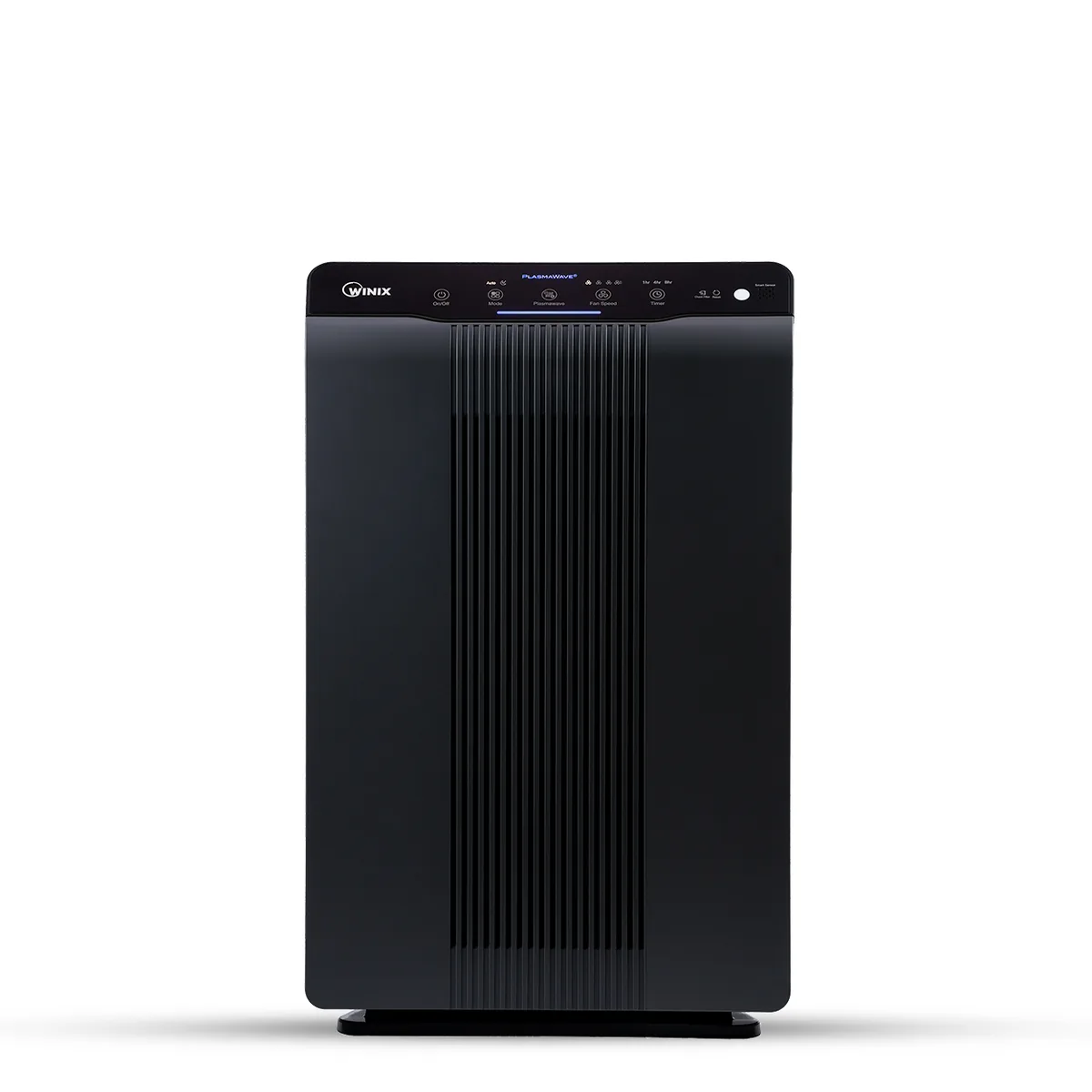
Winix 5500-2
The 5500-2 is air-purifier owner discussions' undisputed value king — the answer to roughly every third 'what should I buy' thread for years. Its AHAM-verified 232 CFM smoke CADR matches the Coway Mighty, but it adds a genuinely useful washable AOC carbon filter (real pelletized-carbon odor removal, not a dusted sheet) and one of the best auto modes at any price, backed by HouseFresh testing that clocked it clearing their test chamber faster than machines costing $100 more. Now the asterisk: Winix confirmed in 2025 that the 5500-2 and 5300-2 are discontinued in North America once inventory sells through, replaced by the Winix 5510. Filters will keep shipping until 2032, so buying one today is still safe, and street prices around $160 (often $130 on sale) remain the class's best CADR-per-dollar. Compared with the Coway you give up a year of warranty and a few dB at the top end (65 dB turbo is loud), and gain better odor handling and the superior sensor. PlasmaWave is Winix's plasma ionizer — it's switchable, and most owners run with it off. If you see it on clearance, this is still the smart-money buy of the entire mid-size class.